Quantitative analysis of form and function across scales
Advancing skeletal imaging and therapeutics through collaboration and research


Education and Training
We aim to establish quality standards in bone morphometry as an essential research tool and to promote the dissemination of new knowledge, technological advances, and approaches to bone morphometry.

Research and Scholarship
Leadership panels include the ISBM Board of Directors, the ISBM Scientific Leadership Committee, the ISBM Early Career Investigator Committee, and the ISBM Working Groups. The full ISBM Congress is held once every two to three years.
Ready to find out more?
We welcome new members at all levels to join our efforts. Membership can be obtained by registering for and attending one of our in-person congresses of the ISBM. Learn more about the upcoming ISBM 2026 meeting here (July 4-7th, 2026 in London, England). Between meetings, new members can join anytime by registering online.
ISBM News

During this webinar Dr. Anjali Kusumbe will present a new and efficient pipeline for clearing and immunolabeling intact calcified tissues, allowing for superfast, single-cell resolution, and quantitative 3D imaging of skeletal elements and discovery of lymphatic vessels in bones. The application of this rapid imaging technique revealed unexpected lymphatic vascular networks in bones, challenging the conventional belief that bones lack lymphatic vessels. Using high-resolution light-sheet imaging and cell-specific mouse genetics, demonstrated the presence of lymphatic vessels in both mouse and human bones. Furthermore, this research uncovers that lymphatic vessel expand in response to genotoxic stress, driven by VEGF-C/VEGFR-3 signaling and stress-induced IL6. During lymph angiogenesis, the secretion of CXCL12 from proliferating lymphatic endothelial cells emerged as a crucial factor for hematopoietic and bone regeneration. Additionally, lymphatic vessel derived CXCL12 induced the expansion of mature Myh11+ CXCR4+ pericytes, which differentiate into bone cells and contribute to both bone and hematopoietic regeneration. The study suggests that targeting bone lymphatics could serve as a therapeutic strategy to stimulate hematopoietic and bone regeneration, particularly in the context of stress and injury, with implications for age-related impairment of bone regeneration.
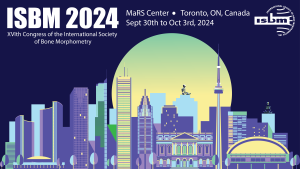
Join us for ISBM 2024 at the beautiful MaRS Centre and Discovery District in downtown Toronto – a chic bioinnovator space with dedicated conference facilities conveniently located just north of the ASBMR conference venue, close to hotels and the University of Toronto. Abstracts are due May 1st!

During this webinar Dr. Morten Frost will discuss incretin hormone-based therapies of common conditions including type 2 diabetes and obesity are rapidly emerging. While preclinical studies indicate that GLP-1 advances bone formation and GIP decreases bone resorption, clinical studies based on early GLP-1 receptor agonists show neutral effects on bone. However, more recent GLP-1 and GIP receptor agonist have dramatic effects on body weight which may have skeletal implications. In the webinar, I will review currently available clinical data and discuss potential effects of incretin-based therapies.

During this webinar Dr. Thomas Andersen will discuss how thousands of bone remodeling units (BRUs) constantly renew our bones throughout our lives. These units are also known as basic multicellular units (BMUs) and involves a highly coordinated bone resorption and formation. This webinar will cover the recently revised phases of the BMUs and the key cellular organization within these phases. These phases include: i) an activation phase that lead to the recruitment and activation of osteoclasts; ii) an initial resorption phase where primary osteoclasts initiate the erosion; iii) a reversal-resorption phase where secondary osteoclasts further expand the erosion, while intermixed osteoblastic reversal cells (osteoprogenitors); and iv) a formation phase where osteoblasts refills the resorption cavity. The webinar will especially focus on the bidirectional cross talk between osteoclasts and osteoprogenitors, which play a pivotal role in the activation of osteoclastic bone resorption and its transition to osteoblastic bone formation. Furthermore, the webinar highlight how a combination of molecular histology and histomorphometry have facilitated these recent advances.

During this webinar Dr. Graeme Campbell will discuss how computed tomography (CT) is considered the “workhorse” of diagnostic imaging in almost all clinical subdisciplines. It is indispensable in terms of its availability, standardization, examination speed and options for integration into complex clinical workflows. In the musculoskeletal (MSK) domain, CT provides high-resolution images of bony structures, e.g. for the diagnosis of fracture or osteolytic/osteosclerotic lesions. Ionizing radiation and relatively low soft-tissue contrast of CT limits the usage of this modality in MSK however. New developments including multi-energy or spectral technology are beginning to widen the scope of clinical applications in CT, resulting in improvements in patient care. This webinar will cover the state-of-the-art in spectral CT and how this technology is re-shaping the clinical standard-of-care in radiology now and in the future.

During this webinar Dr. Sarah Dallas will discuss using live cell imaging in combination with transgenic mice expressing GFP-tagged collagen and fluorescent reporters to visualize bone cell lineages, our work has advanced fundamental understanding of bone extracellular matrix assembly and resorption dynamics. Live cell imaging has revealed the dynamic mechanisms of osteocyte embedding in collagen and their fate after bone resorption. Imaging of osteoclast cell dynamics has revealed novel cell dynamics and real-time mechanisms of bone resorption and allowed us to visualize real time responses to pro- and anti-resorptive agents. Our results show that mature osteoclasts respond dynamically and reversibly to changes in RANKL signaling and highlight the importance of observing osteoclasts and other bone cells in their natural bone environment.
Join the current ISBM President, ISBM President Elect, and ISBM Past President to discuss the state of the field, emerging use cases, and future research and leadership opportunities in skeletal imaging and morphometry.

ISBM Sept 2023 Newsletter: 2024 Congress Website And Speakers , Travel Awards, Webinar Recordings, And More

During this webinar Dr. Michelle McDonald will discuss using a novel intravital imaging technique to visualise tumour cell fate, bone cell dynamics and tumour-bone cell interactions we have advanced our fundamental understanding of tumour cell dormancy and osteoclast biology, and uncovered mechanisms behind clinical responses to anti-resorptive therapies. Through targeting this novel cell biology, we are defining strategies to prevent bone loss in patients who are withdrawn from anti-RANKL therapy. We are also investigating new approaches to prevent bone metastatic tumours indirectly through targeting the bone microenvironment.

Last week the JSBM hosted current ISBM President Dr. Erica Scheller as part of their annual meeting, this year Chaired by Dr. Tadahiro Iimura in beautiful Sapporo, Japan. The leadership of both societes aims to strengthen the ties between ISBM and JSBM through mutual scientific exchange and collaboration.
- « Previous
- 1
- 2
- 3
- 4
- Next »
